612 private links
Sverige
- In Skåramåla (Småland) eight wind turbines combined with 65k PV panels make up the largest "hybrid" renewable power plant in Sweden. In operation since 2024. Expected annual production from wind is 125 GWh, and from solar PV 2 GWh. 1, 2, 3
- In Tomteboda, Stockholm's largest PV roof-mounted plant, produces 400 MWh per year (1465 PV panels covering an area of 4000 m²). Co-owned by Areim and Blackstone and operated by Obligo Real Estate. (2021)
- The largest solar power plant in Sweden is built by a home-owner's co-op (HSB Södermanland) in cooperation with the energy company Energiengagemang. 41600 PV panels with a total power of 14 MW.
- In Morgongåva (40 km west of Uppsala) the logistics center of online pharmacy Apotea features Sweden's largest roof-mounted PV array with a capacity of 2.3 MW, enough to supply the building's entire annual electricity demand. Built by Solkompaniet. SVT.
- The ports of Stockholm and the port of Södertälje together have almost 4 GW of solar PV panels, and have plans for more.
Misr
- Benban solar park in southern Egypt is one of the world's largest PV plants, covers an area of 37 km² and has a power generation capacity of 1.65 GW (given the site's insolation expected to yield 3.8 TWh per year).
- In Kom Ombo, Egypt's largest privately-owned solar PV plant is expected to start commercial operation in January 2024. ACWA Power (Saudi Arabia) owns and operates the 200 MW utility-scale plant.
Europe
- Uniper (the recently nationalised German energy company) plans two PV plants near existing industrial sites in Wilhelmshaven (300 MW + 17 MW).
- Belgium's first floating PV plant. On a man-made lake on a site owned by Sibelco, a raw material producer.
- Spanish energy company Iberdrola commissioned a 500 MW solar PV park at Núñez de Balboa in the western Spanish region of Extremadura. At the time Europe's largest PV plant, as seen by NASA's Earth Observatory. The project cost €300 million and is made of 1.43 million PV panels. Via @S_Johan_Lindahl.
Asia
- I cannot find any updates on the status of the 1.1 GW Al-Henakiyah PV power plant that is supposed to go online in 2025 (or 2026 according to Masdar, which has a nice PDF summary of the project). NS Energy, Masdar
- Announcement of a large planned solar PV plant in Garadagh, Azerbaijan expected to produce 500 GWh annually. To be built by Masdar and it is co-funded by Abu Dhabi Fund for Development, the Asian Development Bank, the European Bank for Reconstruction and Development (EBRD), and Japan International Cooperation Agency. NS Energy
- Oman seems to be on a roll. Their governmental energy company Hydrom (recently created to spearhead their green energy transition) is planning a massive green hydrogen project with a capacity to produce 750 kiloton/year (if I understand correctly). 1, 2.
- In Qinghai province, China, a 2.2 GW solar PV plant was connected to the grid in 2020 (at the time the world's largest solar plant).
Africa
- A large hybrid PV and battery plant has commenced operation in South Africa. The billion-dollar facility is owned by Norwegian Scatec ASA and South African investment company H1 Holdings (51% and 49%, respectively). The plant will supply the state-owned utility Eskom 150 MW of dispatchable power for 16.5 hours per day year-round. The facility comprises 540 MW PV and 1140 MWh battery storage. PV Magazine
Americas
- In the five first months of 2023 the United States power sector saw more electricity generation from wind and solar (combined) than from coal for the first time ever. Many other countries have already passed this particular milestone (or phased out coal entirely), so welcome to the club, yankees, and keep it up.
Oceania
- In southern Australia, a 4 MW concentrating PV plant combined with 50 MWh thermal storage for almost round-the-clock power generation is now in operation. The Carwarp power plant is run by RayGen. The site uses triple-junction GaAs solar modules with almost 38% efficiency paired with water-based thermal energy storage. Each tower (there is four of them) has just over 4 m² of photoactive area producing 1 MW of electricity and 2 MW of heat (ΔT=90℃).
- 10 GW of solar power in Australia for Singapore.
- The largest PV plant in New Zealand sits atop a wastewater pond.
- The Nauru Solar Power Development Project - Battery Energy Storage System is a 6 MW solar plant and a 2.5 MWh battery storage system that will increase the share of renewable electricity in Nauru from 3% to 47% (like many other Pacific islands, Nauru relies almost entirely on diesel generators for power), which is expected to fully cover the island nation's current daytime electricity needs.
In related news
- A look at the major floating solar energy farms across the world, NS Energy Business magazine (2019).
- https://earthobservatory.nasa.gov/images/150232/solar-takes-a-swim
- The UK has designated a project to build a 3800 km undersea cable from Morocco as having "national significance". The project is owned by Xlinks. (2023-10-01)
- The government of Egypt is set on building a subsea cable to Greece to sell solar and wind power to Europe. The GREGY interconnector would be 1400 km long and able to transmit 3000 MW. I wonder if power transmission would be strictly uni-directional or if it is meant to also allow power export to Egypt? (2023-09-30)
Feels like I keep hearing about new FOSS tools and services interfacing with Mastodon every day.
I need some place to keep track of them.
- https://github.com/toelke/mastodon2rss - Serve your mastodon home feed to RSS (including boosts!)
- https://streetpass.social - a browser extension that helps you find Mastodon users as you browse
- https://github.com/nathanlesage/academics-on-mastodon - a collection of various lists of academics on Mastodon servers.
- https://lemmyverse.net - search Lemmy instances or communities
- https://mastogizmos.com - a collection of JavaScript apps to search and explore the Mastodon universe. By https://www.calishat.com. Via https://researchbuzz.masto.host/@researchbuzz/114372841943284024
- https://delightful.coding.social/delightful_activitypub_development - curated list of resources for ActivityPub developers who create software for the Fediverse.
On-boarding people
- https://fedidb.com/welcome, via https://mastodon.social/@dansup/114483074813774602
- https://fedi.tips/how-do-i-find-accounts-to-follow-on-mastodon-and-the-fediverse-how-do-i-find-my-friends
Creating threads
- https://splinter.hastily.cc - split long articles into Mastodon threads. Via https://social.hastily.cc/@neiman/114591328088507928.
- https://rstockm.github.io/mastothread - split your long text into bitesize posts. Via @vicgrinberg.
This is an academic seminar, so not much razzle-dazzle, but the subject matter is certainly cool!
Space-based solar power is the idea to put PV panels on satellites in orbit and beam the power down to the surface.
Do you think that sounds outlandish? Well, there is nothing technical stopping us - just a matter of financing and politics. Not like fusion which is still an unsolved problem. In my book space-based solar would be smarter, cheaper, and more sustainable than even nuclear power.
I have archived a copy of the seminar recording on my Nextcloud (in case you have any problems using the Zoom-provided recording).
- Due to rules severely limiting the allowed sulfur content in fossil fuels for (see, acid rain) over 80% of all sulfur produced globally is a side-product of fossil oil and fossil gas refinement. Unless we find another way to produce sulfur (sulfuric acid is a critical industrial feedstock), the change to renewables could seriously hamper our access to sulfur. Maslin & Day, The Conversation (2022).
- Shell got a lot of good PR a few years ago on the back of news that they would install hydrogen filling stations across California in cooperation with Toyota. Now they have announced their complete withdrawal from light-duty (read: private cars) hydrogen filling stations in the state.
Sounds interesting, but unfortunately the Encyclopedia website appears to be broken.
I sent a question to their webmaster through their contact form.
For the individual owning the car, It is very high. When we take the societal costs into consideration, it is even higher.
- A paper from Gössling et al., 2019, "The Social Cost of Automobility, Cycling and Walking in the European Union", 10.1016/j.ecolecon.2018.12.016, via CityNerd (youtube video).
- Another paper by Gössling et al. in Ecological Economics, 2022 was really eye-opening. Over 50 years, the total lifetime cost of ownership of a "cheap" car will reach 600,000 EUR, out of which almost a third is effectively a subsidy from society to the car's owner. If you are considering owning your own car, I strongly recommend to at least skim this paper (CC license, HTML and PDF freely available).
- Another paper (Mattioli et al., Energy Research & Social Science, 2020), this is one is a review that considers our car dependence from a systems of provision approach. Quite interesting if you want to learn more about the of the political-economic underpinnings of car dependence (CC license, HTML and PDF freely available).
- A 2023 paper that tells how the car industry has deliberately pushed motorists into greater debt in order to save itself: The financialisation of car consumption. Nice summary in this Mastodon thread.
The Gössling paper generated some news items across the web, for example
- Kea Wilson, StreetsBlog USA, 2022. Takes an American perspective, which mainly means that everything gets worse.
- Carlton Reid, Forbes, 2022. Again, puts an American perspective on the numbers, but correctly states that "cars suck more cash than most people imagine".
I also remember a Youtuber doing a nice video on the Gössling paper, but I cannot recall enough about it to find it at the moment. Maybe I will find it later.

When writing in R Markdown format I often would like to comment out one or more lines of text (for example to quickly test variations on sentences or paragraphs) in a way that these comments do not show in the generated HTML file.
The R Markdown Cookbook only mentions HTML comment syntax <!-- your comment --> which does not stop the comment from remaining in the generated HTML file.
Best solutions, as far as I know:
Additional YAML blocks
Add a YAML block with commented out lines (baptiste's suggestion):
Some text in the document.

---
# commented out text
# and such
---
This works fine, it is just slightly verbose to use.
But it is the only option that works without any issues.
Abuse the markdown link labels syntax
This is the most popular answer (by far) on SO:
Some text in the document.

[//]: # (commented out text)

[//]: # (another comment)
According to other answers/comments, this sort of comment line should always have a blank line before it to be proper (but in my experience, that rule can be bent).
In Python Markdown (or perhaps more generally anytime the intended output is HTML, I'm not sure) never indent such a comment line, i.e., never prepend any whitespace on the line, or else browsers may break HTML list items in unexpected ways (may break in Firefox but not Chromium, or vice versa). So no whitespace before the comment!
The drawback for Rmd appears as soon as we have more than one such comment line; knitr spits out a very visible warning in the standard output:
[WARNING] Duplicate link reference '[//]' at ... line ....
The only(?) way to avoid those warnings is to differentiate the link labels, but that quickly becomes tedious.
Some text in the document.

[//1]: # (commented out text)

[//2]: # (another comment, now without a knitr warning)
If you know of a less verbose method than adding YAML blocks, or an easier way to circumvent the knitr warnings, I would love to learn about it.
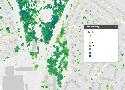
Kartläggningen ger en bild av nuläget i 200 tätorter med fler än 5000 invånare. Boverket refererar till den allt oftare uppmärksammade 3-30-300-regeln, det vill säga att man ska kunna se tre träd från sitt fönster, att 30 procent av stadsdelen ska vara täckt av träd och att de boende ska ha max 300 meter till ett grönområde.
Via Arkitekten.se

Art courtesy of blog.akhbarak.net.
The post title is the translation of the meaning of verse 5 of chapter 42 (Ash-Shuraa) of the Holy Quran.
A nice series of lectures from MIT on the 20th century history of physics (Maxwell's equations, light quantisation, etc.) by David Kaiser. Recorded in fall 2020, just recently shared on their OpenCourseWare youtube channel:
Passwordstore is a great password manager, and I rely on it also in my Ansible playbooks, where it works by causing the gpg-agent to prompt me for the passphrase of my gpg key.
This prompt is a GUI prompt, which is very suitable when sitting at the computer in question. But a small annoyance is that it does not work at all when working on a remote computer via ssh (the prompt shows up on the remote computer's desktop, and the Ansible playbook in the terminal just freezes until it eventually fails).
It would be so much nicer if those ssh terminal sessions would instead get the gpg-agent prompt in the terminal. So far I have not found a method that achieves this without also sacrificing the GUI desktop prompt for non-remote work.
Desktop and laptop running Ubuntu 22.04 with i3wm desktop.
The relevant parts of my config can be seen in https://codeberg.org/ansible/dotfiles.
I considered the following related Q:s&A:s but did not achieve the desired outcome.
- https://unix.stackexchange.com/questions/554153/what-is-the-proper-configuration-for-gpg-ssh-and-gpg-agent-to-use-gpg-auth-sub
- https://stackoverflow.com/questions/17769831/how-to-make-gpg-prompt-for-passphrase-on-cli
- https://superuser.com/questions/1189602/how-to-configure-gpg2-to-ask-for-passphrase-on-the-console-instead-of-in-a-popup
- https://unix.stackexchange.com/questions/217737/pinentry-fails-with-gpg-agent-and-ssh
Some more tests
In the SSH session (no effect, unfortunately):
gpg-connect-agent updatestartuptty /byeLearned that the gpg-agent is running in --supervised mode, and its ENV variables include DISPLAY=:0:
solarchemist@desktop:~
$ sudo cat /proc/2652288/environ
HOME=/home/solarchemist LANG=en_US.UTF-8 LC_TIME=sv_SE.UTF-8 LOGNAME=solarchemist
PATH=/usr/local/sbin:/usr/local/bin:/usr/sbin:/usr/bin:/sbin:/bin:/usr/games:/usr/local/games:/snap/bin:/snap/bin
SHELL=/bin/bash SYSTEMD_EXEC_PID=2652288 USER=solarchemist
XDG_DATA_DIRS=/home/solarchemist/.local/share/flatpak/exports/share:/var/lib/flatpak/exports/share:/usr/local/share/:/usr/share/:/var/lib/snapd/desktop
XDG_RUNTIME_DIR=/run/user/1000 QT_ACCESSIBILITY=1
DBUS_SESSION_BUS_ADDRESS=unix:path=/run/user/1000/bus DISPLAY=:0 XAUTHORITY=/home/solarchemist/.Xauthority
MANAGERPID=1532 LISTEN_PID=2652288 LISTEN_FDS=4
LISTEN_FDNAMES=browser:extra:std:ssh INVOCATION_ID=<stuff> JOURNAL_STREAM=<stuff>
(the PID of the gpg-agent process is easily identified with ps aux | grep [g]pg).
Manual work-around
Manual work-around is to set pinentry-program /usr/bin/pinentry-tty in ~/.gnupg/gpg-agent.conf and reload the agent gpg-connect-agent reloadagent /bye.
To revert to the default (GUI) pinentry behaviour, just remove the line and reload the agent again.
How could we go about to draw a straight line (vertical or horizontal) on top of any other window on our Linux desktop? I'm using i3 window manager with picom compositor at present, so I'm primarily interested in solutions that works for that.
I should get back to this question in the future and implement a nicer solution than pango-view
pango-view
Produces a vertical line (actually, more of a vertical box of limited width).
Very easy to make it, just issue the command in a terminal. pango-view was already installed.
$ pango-view --height=99999 --margin=1 --background=red -t ''- https://forum.puppylinux.com/viewtopic.php?p=76743 relevant, very good and recent
- https://askubuntu.com/questions/328543/are-there-any-tools-for-drawing-on-the-desktop-drawing-over-apps
gromit-mpxis a good over-app painter, but does not provide perfectly straight lines- https://www.linuxfordevices.com/tutorials/linux/tools-to-draw-on-linux-screen

Using biblatex with a numeric style and a book class with frontmatter/mainmatter, would it be possible to have all citations in the frontmatter appear last in the list of references, as if the frontmatter (from biblatex's point of view) appeared after the mainmatter?
\documentclass{book}
\usepackage[utf8]{inputenc}

\usepackage[backend=biber,sorting=none,style=nature]{biblatex}
\usepackage{filecontents}
\begin{filecontents}{\jobname.bib}
@misc{hydrogen,
  author = {Author, A.},
  year = {2001},
  title = {Alpha}}
@misc{neodymium,
  author = {Luthor, Lex.},
  year = {2002},
  title = {Bravo}}
\end{filecontents}
\addbibresource{\jobname.bib}

\frontmatter
\cite{neodymium}

\mainmatter
\cite{hydrogen}

\backmatter
\printbibliography[title={List of references}]

\end{document}
In the above MWE, references in the "List of references" are printed in the same order as they were given in the document, so neodymium would be listed before hydrogen in the "List of references".
This also means that the citation in the frontmatter would be labelled [1] in the text and the first citation in the mainmatter would be labelled [2].
This is just as expected with the numeric style as often used in science and engineering theses.
I wonder if there is some way to make the first citation in the mainmatter be [1] (because it might be jarring for the reader to see the first citation in the first chapter be something like [11], it may make them wonder what they missed), without having a separate \printbibliography for the frontmatter (nor using refsection or refsegments, because I don't think they will help in this case). Preferably any citations in the frontmatter would simply be appended to the end of "List of references", as if the frontmatter was processed after the frontmatter by biblatex.
I think this would be hard to achieve. But I'd like to hear if anyone knows better?
Would something like this be possible? Have I missed something obvious?
I have read the Sorting section in the biblatex manual, and read these related (but not-very-pertinent) questions on TeX.SE
- https://tex.stackexchange.com/questions/540610/numbering-issue-in-printbiblography/540615
- https://tex.stackexchange.com/questions/306678/biblatex-have-two-separate-bibliographies-with-consecutive-numbering
- https://tex.stackexchange.com/questions/244150/citations-out-of-order-with-appendix-and-split-bibliographies-in-backmatter
Would it be possible to add a comment system to Shaarli posts?
It seems so.
- Add Disqus or Isso comments box on a permalink page [#181](https://shaarli.chepec.se/./add-tag/181)
- also see Shaarli plugins, may be some ready-made solution out there.
Road vehicles
- The Hague is the first Dutch city with a taxi fleet running on H₂ (Toyota Mirai, specifically) (2020-04).
- As part of the European Commission's JIVE project, a dozen H₂ buses for Bolzano, Italy. The buses are manufactured by Solaris and have a range of 350 km on a single tank of LH2 (2019-07).
- FlixMobility (parent company of Flixbus) plans to operate fuel cell coaches on long-distance routes (2019-11). This as part of the research project HyFleet together with its partners Freudenberg Fuel Cell e-Power Systems and ZF Friedrichshafen AG, overseen by the German Federal Ministry of Transport and Digital Infrastructure, with start of commercial operation slated for 2024. More sources: 1.
- The first H₂-powered double decker buses have started operation in Aberdeen, UK (2021-02). The project was funded by the city, the EU, and the Scottish government, for 15 buses costing about 0.5 million GBP apiece.
- Gross-Gerau district in Germany plans for 80 H₂-powered buses in its fleet by 2028. I wonder how many buses the city operates in total.
- Hyundai plans to sell 1600 heavy trucks in Europe, and cooperates with Hydrospider for the H₂ supply.
Trains
- San Bernardino county in California awarded a contract for a H₂-powered train in 2019 to Stadler to run by 2024. I thought southern California was densely populated - why not electrify the tracks? Fuel cells are better than dirty and loud diesel locomotives, I suppose. This is the first H₂ fuel cell train in the US, and many other places in the US are quite sparsely populated, so let's hope it is followed by more.
Ships
- The Norwegian Public Roads Administration is to operate the world's first H₂-powered ferry connecting its fjords. The ship is built by Norled and has a carrying capacity 299 passengers and 80 cars. Details on its power train have not been forthcoming.
- A river vessel on the Rhone river with a powertrain built by ABB, supported by the European Commission's Fuel Cells and Hydrogen Joint Undertaking (FCH JU) and in cooperation with other parties.
- The first H₂-powered ferry in the US has started serving San Franscisco Bay. It takes 75 passengers, has three fuel cell stacks, and a top speed of 20 knots. The project was awarded a $3 million grant by the California Air Resources Board. For reference, there are about 1000 passenger ferrys operating in the United States.
- The world's first LH2 carrier has been put into service ferrying grey H₂ (meaning H₂ produced from fossil sources) from Australia to markets in Japan. The vessel was built by Kawasaki Heavy Industries and comes equipped with a tank able to hold 1250 m³ of liquified H₂ at a temperature of -253℃ (20 K).

Midsummer får 32 miljoner euro (ca 300 miljoner kronor) från EUs innovationsfond för att bygga en CIGS tunnfilmsfabrik om 200 MW i Sverige.
I am heavily indebted to Hoger Gerhardt for posting his example on TeX.SE.
I chose to put a DOI symbol (thanks to the Academicons package) at the end of each bib entry. I think it looks rad.
\usepackage[backend=biber,date=year,doi=true,url=false,style=nature]{biblatex}
\usepackage{fontawesome5}
\usepackage{academicons}
\usepackage{hyperref}
\renewbibmacro*{finentry}{%
   \iffieldundef{doi}{%
      % Entry lacks DOI
      \iffieldundef{url}{%
         % Entry lacks URL and DOI
         \finentry%
      }{%
         % Entry has URL but lacks DOI
         % Show URL hyperlink as icon (concsiously not using same icon as our "external hyperlinks")
         \finentry\space%
         \href{\thefield{url}}{\footnotesize\faIcon{link}}%
      }%
   }{%
      % Entry has DOI \aiDoi
      \finentry\space%
      % lower the DOI  symbol a little to align better with baseline
      \href{https://doi.org/\thefield{doi}}{\raisebox{-0.1ex}{\aiDoi}}%
   }%
}%
% suppress output of DOI field (hide both DOI label and string)
\DeclareFieldFormat{doi}{}%
Here's an example of how the typeset bibliography entries look like (please excuse the poor resolution, the screenshotter suddenly decided to drop the quality):

Will add more as I learn about them. I only care about FOSS projects.
LXD
See my Ansible role that installs and configures LXD and provisions LXC containers.
Docker
I have some experience with Docker containers. Prefer LXC if I have the choice.
I have written an Ansible playbook to setup containers with docker-compose as part of a as-yet not-public project for InvenioRDM.
Podman
No hands-on experience yet.
Singularity
Hm, interesting. Could it be better than Docker for sharing something like a thesis with "all batteries included", I wonder?
Singularity can convert Docker containers to Singularity, or can run containers directly from Docker Hub
https://blogs.oregonstate.edu/learningbydoing/2022/01/04/docker-and-singularity-containers-which-one-is-better/
Sverige
- Map (maintained by the association of the Swedish Energy companies, aka "Energiföretagen") of Swedish green hydrogen projects as of 2024.
- In Älghult, Kronoberg county, Metacon and Uppvidinge Vätgas have launched a H₂ filling station connected to its own electrolyser powered by a dedicated wind turbine, making the station self-sufficient. No word on the technical details yet. (2023-09-01)
- 20 MW electrolyser in operation at Hofors mill, operated by Ovako and delivered by Hitachi Energy (formerly ABB, if I'm not mistaken). It seems to be getting its power from the grid, not any dedicated PV or wind plant. The produced hydrogen gas (3500 m³/h) is used to heat steel before rolling and also to fill fuel cell trucks. The project is the result of a collaboration between Ovako, Hitachi Energy, Volvo, H2 Green Steel, Nel Hydrogen and supported by the Swedish Energy Agency (2023-09-05).
- The world's first off-grid and public hydrogen refill station was installed in 2019 in Mariestad, Sweden. Electricity from a 250 kW PV array is used to run an electrolyser with the ability to produce 46 ton H₂ per year. The station has two storage tanks with a total capacity of 345 kg H₂ at 200 bar. Anyone can fill up their tank with H₂ at 700 bar at a cost of 90 SEK/kg, and the station itself required an investment of 30 million SEK, most of which was financed via grants (mostly from the EU). This refill station should soon be joined by others in Sweden under the "Nordic Hydrogen Corridor" banner. Technical know-how behind this project was provided by Nilsson Energi as well as researchers from Stockholm university, KTH, and Uppsala university. This project has been mentioned in other sources: 1, 2, 3, 4.
- Mariestad municipality (again), I suppose riding high after their success with the off-grid H₂ refill station with storage and PV, has set out to build a preschool that would be completely energy independent by having its own PV panels on the roof and a battery storage bank large enough to cover two days consumption, along with an electrolyser and H₂ storage tanks. The battery bank will even out daily energy peaks, and the stored H₂ is meant to cover electricity and heating during the less-than-sunny Nordic winter (by means of a fuel cell). More sources: 1, 2, 3, 4. The project ran into regulatory issues, but they were resolved, and the preschool including its off-grid-capable energy system was inaugurated in January 2022.
- A small-scale electrolyser in Umeå, Sweden (running off-grid, it seems) operated by Svevia (a government-owned corporation) and meant to supply two of their own fuel cell vehicles. The electrolyser was supplied by Oazer. At present, this is only the fourth such electrolyser in operation in Sweden.
- Spanish fertiliser company Grupo Fertiberia intends to build a 600 MW water electrolyser in the Luleå-Boden area by 2026 at the earliest, fed with renewable electricity from nearby hydropower and windpower. The produced H₂ will be used to synthesise NH₃ (1500 ton/day), which would in turn feed a new fertiliser plant (to the tune of half a million ton per year, would be Sweden's first and only; Sweden imports around 600 000 tonnes per year). Via InvestInNorrbotten (in Swedish), Grupo Fertiberia (PDF), and Cornucopia (in Swedish).
- Uppsala Vatten och Vattenfall ska bygga en station för vätgas-tankning av tunga fordon, stöds med 48 MSEK från Energimyndigheten.
- Uppsala Vatten får 2 miljoner SEK i EU-stöd för att planera vätgasproduktion. (Energinyheter.se)
Misr
The political and legal conditions for hydrogen projects in Egypt is improving.
- The Norwegian firm Scatec will build and operate a 100 MW PEM plant near Ain Sokhna producing green H₂ plant intended as feedstock for nearby green ammonia production in cooperation with Fertiglobe PLC. The electrolysis cells will be supplied by Plug Power, and local works by Orascom. (2021-10) This project may also involve MEP and Petrofac (it's unclear to me at the moment if this refers to the same ammonia plant, likely the case).
- Positively massive project, if implemented: 7000 km² of PV and/or wind turbines planned to feed 90 GW of electricity to generate H₂ from water. For comparison, that's an area equivalent to more than 175 Benban's and a nominal power capacity 45x the same. Via FuelCellsWorks and ArabNews. I'm not sure this is feasible, to be honest. I will wait for confirmation.
Europe
- The HOPE consortium plans to build the world's first offshore green hydrogen facility by 2026. The consortium consists of several European companies and is backed by the European Commission. The plan consists of wind power supplying a 10 MW electrolyser fed with treated ocean water and a H₂ pipeline back to shore.
- Uniper and other German companies area currently constructing a 30 MW electrolyser which will be the centre-piece of the Bad Lauchstädt Energy Park, an investment of over 200 million EUR. The hydrogen will supply the TotalEnergies Refinery Central Germany some distance away (the project includes building a pipeline). (2023-06)
- Danish power supplier Ørsted received DKK 35 million from the Danish Energy Agency to build a 2 MW electrolysis plant with attached H₂ storage in partnership with Everfuel Europe A/S, NEL Hydrogen A/S, GreenHydrogen A/S, DSV Panalpina A/S, Hydrogen Denmark and Energinet Elsystemansvar A/S. 600 kg H₂/day, or enough to power around 20 buses.
- Hydrospider operates the largest hydrogen electrolyser in Switzerland at Gösgen with a capacity of 2 MW powered by hydro, able to produce up to 300 ton of H₂ per year (enough for around 50 heavy trucks).
- Shell opens a 10 MW PEM electrolyser at its Rheinland oil refinery in Germany. The plant is slated to start operation in 2024 and produce up to 1300 ton of green H₂ per year. The plant, currently Europe's largest PEM green H₂ electrolyser, was funded by Shell in joint cooperation with the European Commission's Fuel Cells and Hydrogen Joint Undertaking (FCH JU) (2021-07).
- Nel Hydrogen Electrolyser, a division of the Norwegian company Nel ASA, is supplying Iberdrola 20 MW of PEM electrolysers for a green fertiliser project. Press release, SR Vetenskapsradion.
- Icelandic company Carbon Recycling International (CRI) produces methanol (CH₄) from CO₂ collected from a nearby geothermal power plant and from H₂ electrolysed from water using renewable generated electricity in a plant with a capacity of 5 million litres of CH₄/year situated on the outskirts of Reykjavik. Chinese carmaking company Geely (also owners of Volvo Cars) invested in CRI in 2015, and partnered to build what would be the world's largest CO₂-to-fuel factory somewhere in China, planned to recycle 160 000 tons of CO₂ emissions from steel plants every year.
- As part of the H2FUTURE project (a cooperation between Siemens, the Austrian power grid, and others and backed by the European Commission's FCH JU project) 6 MW of PEM electrolysers from Siemens will produce H₂ for steel production at the Voestalpine steel mill in Austria.
Japan
- Fukushima prefecture, Japan, aims to cover 100% of its energy demand with renewable sources by 2040, and towards that aim has built a 10 MW electrolyser that runs off a 20 MW photovoltaic park in cooperation with the National Institute of Advanced Industrial Science and Technology. The electrolyser has a rated capacity of 1200 m³/h H₂(g) (approximately 841 ton/year if my math is correct, assuming NTP). Via @S_Johan_Lindahl.
Asia
- A massive (planned) expansion of the Mohammed bin Rashid (MBR) solar park in the UAE brings it total capacity to over 4.5 GW, well on the way to the project's target of 5 GW by 2030. This latest addition cost (LCOE) 1.62 cents/kWh (USD). (2023-09-07)
The solar park is apparently meant to include electrolysers too.